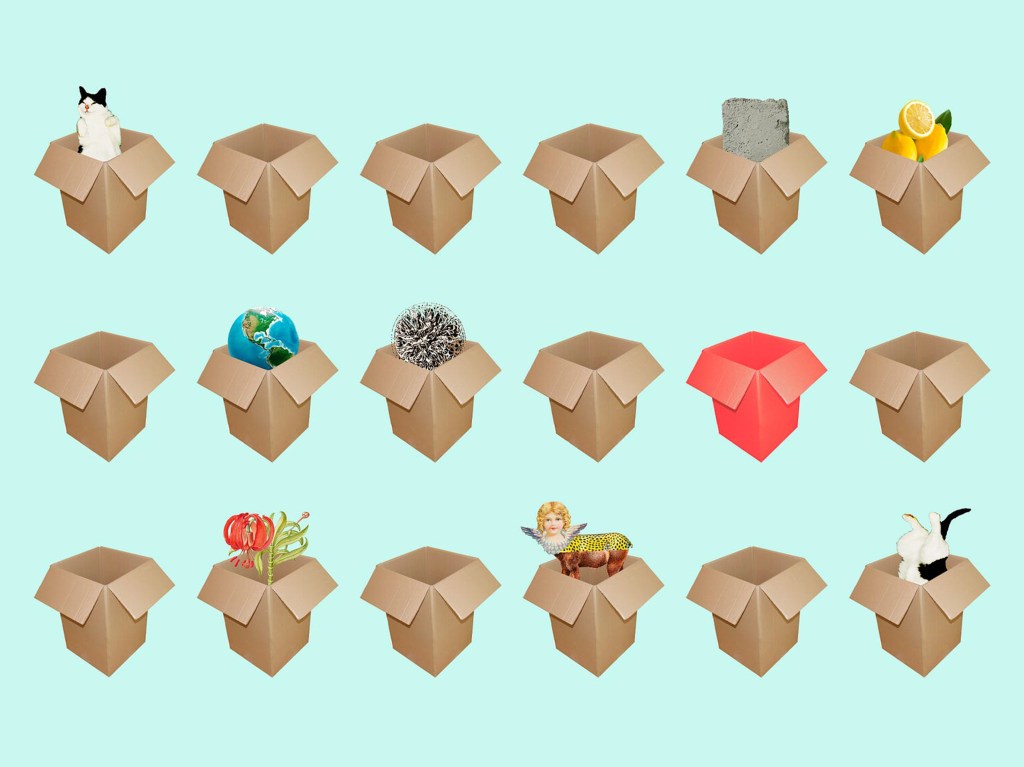
What does a collector personality see when they watch ”Box of Lies”? If you ever wanted to know, this essay is for you.
Introduction
There are many ways of dividing humans into categories. There are dog people and cat people. Some people love olives, and other people hate them. Some people pour the cereal first, then milk… and then there are psychopaths (I am kidding, ok?). To me, perhaps one of the most fascinating divides is between people who collect things and people who do not.
I am a collector personality myself. For me, collecting is driven by a deep appreciation of the beauty and/or function of an object. Non-collectors, on the other hand, might see collecting as synonymous with hoarding. Let’s dive into the differences of these two activities for a bit. Then I will tell you about the “Box of Lies” dilemma…
The line between hoarding and collecting can be fine, but I would draw it with the help of these 3 principles:
- Hoarding seems to often be associated with hoarding syndrome, which is a psychological disorder. A pathological hoarder is a person who has developed an obsession with accumulating a certain category or categories of objects (such as food or hygienic products) beyond their usability. To them, their collection of items poses a grievance that often limits their everyday lives in many different ways, starting from social. Collecting, on the other hand, is generally understood to be a hobby, a sort of source of joy in one’s life, and usually remains within or plays around the limits of social acceptance.
- Hoarding usually entails compulsively acquiring many identical things. Collecting, on the other hand, tends to be more oriented towards different things, albeit within the same category. The category can also be very wide and revolve around only one or two criteria, such as in the case of The Green Lady, or very specific, such as in the case of the occlupanids.
- Hoarding as a lifestyle usually manifests itself as an overwhelming amount of clutter in a home. Collecting, on the other hand, tends to be seen as a more controlled activity. The collectibles are often organized in display cabinets or integrated into a home in a way that expresses the identity of its owner.
It can be difficult to tell when accumulating things supports one’s overall well-being (=collecting as a hobby) and when it slips into psychologically harmful territory (=hoarding as an obsession). I am going to make my life a little easier and say that is a subject for another essay.
The art of noticing Easter chicks
Now that we have established the difference between hoarding and collecting, we can dive into the subject I want to discuss: Detail orientation in the context of object admiration.
What does this mean in practice? Let’s say, for the argument’s sake, that I like vintage postcards (which I do). I started to collect them many years ago, and now I have a small collection of what I consider to be semi-rare cards from the period of the 1890s to the 1950s, as well as others that I also use as cards and material for my art.
Initially, as I looked for cards at thrift stores, I was mainly able to distinguish wide vintage card categories, such as Easter cards, for instance. I then quickly learned that there are a lot of Easter cards with chicks on them. Later, I started to notice the different subject matter categories in Easter chick cards. Before I knew it, I was dividing Easter chick cards into categories such as “chicks sitting in a wheelbarrow with purple and yellow pansies” or “chicks with a scary bunny friend”, and determining their release date based on the thickness and quality of the paper.
At this stage, if you are not a collector, you will probably feel the urge to cite the legendary Kimberly Wilkins, but if you are, I know you know what I am talking about.
Depending on how much time one has on their hands, acquiring and admiring certain collectibles will inevitably teach one to be more in tune with fine detail. In other words, collecting will force you to become an expert on the nuances of whatever it is that you are collecting. This is how part of the drive behind collecting things is formulated, at least in my case. The more specific the collecting category, the subtler the differences between the collectibles, and the more knowledgeable and detail-oriented their admirer needs to be to distinguish the collectibles from one another. For example, in the case of Easter cards, the difference between two collectibles can be as slight as the shade of green in two different editions of the same card.
But is the addictive cycle of learning about the collectibles the only drive behind the urge to collect? Of course not. As an artist, I draw a lot of inspiration for my work from the collectibles I own, and so, there is a strong utilitarian aspect to my collecting. Even among non-artists*, there must be many other reasons why one would rather collect than simply admire an object without possessing it.
Nearly as much as collecting is about the appreciation and the joy of owning an object, it is also about classifying it. As soon as an object exists, it will fall into some kind of category, starting from ”miscellaneous” and ending in archival hierarchies that cascade longer than Jacob’s Ladder. There’s a certain psychological comfort in being able to put things into clear categories; it is like reorganizing the junk drawer** of your mind. And naturally, it follows that if an item does not fit any category, it causes discomfort and frustration in us.
Speaking of categorical discomfort: at this stage, you are probably wondering if I will ever tell you what the “Box of Lies” dilemma is. And yes, I will — in fact, this is the perfect moment for me to open the gate and let that gaggle in the courtyard.
The “Box of Lies” dilemma
If you are familiar with The Tonight Show Starring Jimmy Fallon, you might already know what “Box of Lies” is. For those who are not, I will try to summarize it without getting into too much detail. Essentially, it is one of the many mini games of the show and features Jimmy Fallon himself, along with his celebrity guest of the day. The idea of the game is simple: Two players take turns selecting a box from a shelf containing an obscure object. One player describes the contents of their box to the other, who then has to guess whether their description is true or false. Whoever guesses correctly wins the round.
The catch of the game is that the objects are always specially made for the show, more or less ridiculous, and hard to describe. After the mind games (TBOL is surprisingly tactical), the reveal of the object is usually a dramatic, thoroughly humorous moment. There are several dozen “Box of Lies” video clips on YouTube, but if you want to get the gist, just watch this masterful play by Chris Pratt.
Now, I can finally present you with the dilemma, which is simply this: Why does nobody really seem to care about the content of the boxes? I could spend hours learning about the items Jimmy Fallon’s team of creatives has put together, analyzing them as objects of surreal art . However, people in the YouTube comments tend to just talk about the interactions between the players.
The collector in me is beyond curious to hear the stories of the people who made the objects and why they made them like they did. I could even travel to see an entire exhibition about the objects and their background. In the meantime, some YT comments do mention the objects, but they remain so firmly on the surface level that you could summarize almost all of them like this: Who comes up with these odd objects, and what have they smoked?
To me, this level of disinterest is an outrage. And I shall have my revenge now. To make things right, I am telling you, my dear reader, to take a moment and really stop and look at the objects in the show. Because there are many interesting questions to ask.
Reality through fake diamond swimming goggles
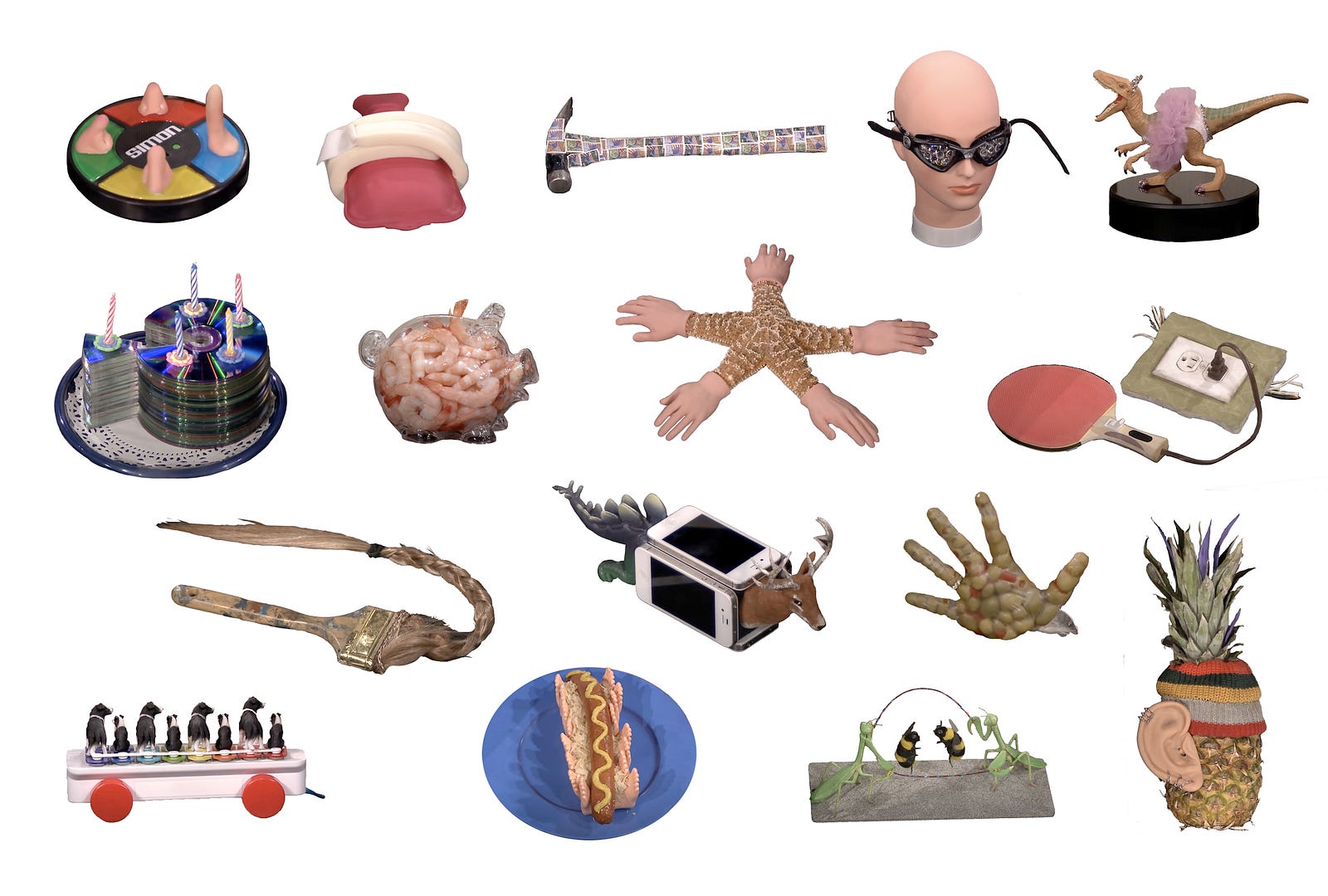
Above, there are some of the objects used in TBOL. Take a moment to take them in. How do these objects make you feel? What do they make you think of? This is where the discomfort I mentioned before might kick in, since none of these objects seem to fit into any pre-existing category. Let the frustration, amusement, confusion, anger, disgust, or whatever other thing you might be feeling looking at them, come and go. Then ask yourself: what are these objects, exactly?
Now, take a look at their construction. At first, the objects seem to be completely random. However, soon, you will start to see how they are all made with other recognizable objects by mashing them together in various ways. While some objects do this in a way that makes it easy to visually separate the parts (such as the funky pineaple with a fake ear and a beanie, the dino in a tiara and a tutu, and the mannequin head with fake-diamond-filled swimming goggles), some others are so strange, it might take you a while to even figure out what they are (olive-filled plastic glove and a paint brush with a braided brush portion, for example).
Sitting in the strangeness of the objects has so much potential for intellectual gymnastics. So, let´s take one of the objects as an example for deeper scrutiny. Swimming goggles filled with fake diamonds are strange, and we all agree on that. But why are they strange, exactly? Another question that might pop into your head immediately when you look at the goggles is: why would they be filled with fake diamonds? So, let us not dismiss these questions as trivial. Let us really get into it.
We usually use the goggles to see, and because of this, they shouldn’t be filled with anything. When they are filled, our brain interprets that there’s something amiss. As for the choice of fake diamonds, it could be that the person who put the object together made a random choice. However, since we humans are not shuffling machines, I would argue that the choices that lead to the specific combination of elements are at least subconsciously justified. The whole combination may be a linguistic or cultural reference. Or maybe he or she liked the fake diamonds, because they are somewhat of a version of water. As someone who remembers that annoying feeling of my swimming goggles being full of water as a child, I certainly find that possibility reasonable.
Stream-of-consciousness design
As I have demonstrated above, questions about nonsensical objects might appear useless at first, but they actually bring us into the realm of the philosophy of meaning and social constructs. The goggles are strange because they are useless, and therefore, they have a quality of meaninglessness to us. But they are useless for the simple reason that, as of now, there is not an assigned function for them in this reality.
The irony is that once they are featured in TBOL, they have at least one assigned function – to be featured in TBOL. And so it might be that the next time someone makes a statue by putting swimming goggles on a model head and filling the goggles with fake diamonds, we recognize them as props for TBOL, and put them now into a category ”props for TBOL”. And we might feel good about how that ever so subtly alleviates our discomfort over them.
I recently saw a video (unfortunately, the source is now lost) about how we tend to lose our interest in the essence of things once we have a label for them. A child, for example, may stop contemplating an object as soon as they have a simple label answer to the question: What is that? The swimming goggle statue, then, would lose its intrigue once it has a function as a prop to a TV show. I recognize this tendency of labeling and forgetting in myself, as well. It simply makes thinking easier.
However, whether it is the artist or the collector in me, someone is not quite satisfied with simply putting an item into a category ”props for TBOL” and leaving it there. Someone in me keeps wondering and delighting in the creative choices that went into designing it.
I really am fascinated by even the ugly box items. And I appreciate them way beyond their functionality or beauty (both usually nonexistent). I appreciate the surreal humor and the obscure references. The method with which they are put together reminds me of stream-of-consciousness writing, and I keep wondering if they were all created with some kind of conscious principle. A hot dog made with baby doll feet certainly feels like a fetish jab (Tarantino, I am looking at you), which is interesting, if not slightly off-putting. And who can look at a birthday cake made from CDs and not ponder about the millennium fever??
Simon says ”just look”
Except for the jump rope scene with praying mantises and bees (so cute!), I would not want to collect the objects in TBOL. Apart from being too big, too odd, too ugly, and often perishable, they tend to have blatant Freudian overtones, which I like to avoid in my collectibles (”Simon” with different sizes of fake noses glued to it, I mean, c’mon :D). I like to choose what to collect while balancing between what is convenient and what is delightful to possess. As much as I do not like to sound like Marie Kondo, collectibles are the epitome of an item that “sparks joy”, and they should remain that way.
I would not like to collect TBOL items, but they fascinate me nonetheless. Reading the comments on the video clips on YouTube, I have come to notice I am quite alone in this. In mainstream media video clips such as TBOL, the conversation is naturally going to revolve around the human interactions – after all, people tend to orient towards other people, not objects. But there is a hidden treasure waiting for those who watch TBOL and really look at the objects.
Looking may spark innocent questioning of your sanity and the set designer’s. But if you keep looking, before you know it, you will find yourself at the golden gates of the philosophy of meaning***. Those gates are a good place to stand in front of, for the views are vast and wonderful, and they look straight into the subconscious of the common mind.
That is the beauty of creative design, even when it comes to ridiculous objects.
*What is an artist and is this divide between artists and non-artists even sensible? Those are valid questions and once again, I could write a whole another article or even a book about this subject, too. To summarize my thoughts: To me, an artist is someone who creates pieces of art, be it physical, virtual, conceptual or any other kind (music, performance, visual — all the established genres are included here, and probably a whole bunch of others non-established), as opposed to a person who uses their creativity in their daily life, such as problem solution in their work, or taking care of their family, or coming up with ways to help their community, etc., but does not produce pieces of art. The next problem is to define a piece of art. I will leave this for some other time…
**Fun fact: in Finnish, we call it the ”million drawer”, because there could be millions of items in there, who knows.
*** I admit, a visual for this I am thinking about are those gates in Hercules. Quite jarring how much mental real estate a major corporation has managed to rent in this 90s kid.

This article was written using only natural stupidity. I hope you get the joke, because I do not want to farm engagement for the real keywords, if I can help it.
The collection of objects from TBOL is featured for analytic purposes.


Vastaa