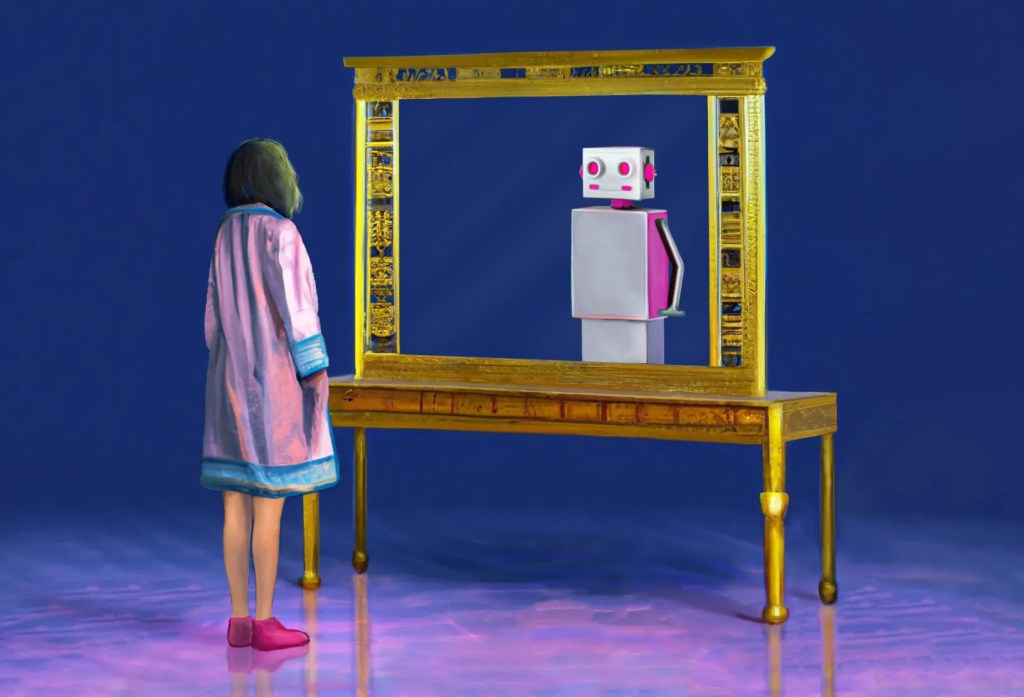
Humanity´s fascination with non-human sentience is as old as time. I say it´s not too late to update our dreams.
As I have established in my previous blog post on literary classics, fiction can reveal the emotional connections humanity has with a certain phenomenon. Lately, I have been thinking a lot about AI and its manifestations in fiction, be it literature, cinema, or anything else.
AI through the lens of fiction
Artificial life has been the subject of stories since the dawn of time. In Greek mythology, even humanity itself has been told to be artificially created by Prometheus the titan. Some see this myth as an early precursor for androids. But many agree that one of the earliest depictions of AI (as we understand the term now) can be found in Samuel Butler´s novel Erewhon dating back to 1872. In Erewhon one of the most classic themes in science fiction was established — the potential danger that lies within the development of artificial intelligence.
Ridley Scott´s science fiction masterpiece Blade Runner, an adaptation of Philip K. Dick’s 1968 novel Do Androids Dream of Electric Sheep? deep dived into the concept of human-like intelligence in 1982. Set in Los Angeles in 2019, Blade Runner paints a picture of an advanced but decaying society, the technological advancement of which has allowed the development of humanlike machines called replicants. While the movie is generally considered a dystopian vision of artificial life, I see it quite differently. To me, more than anything else, it is a wild, optimistic dream of what science could one day achieve.
This dream is embodied in the character of Rachael, a nearly perfectly human replicant. Rachael can feel, want, and make decisions just like you and me. The concept of Rachael bases itself on an optimistic assumption that we as humans can be creators.* We don´t have to be all alone in the universe, because we can create more intelligent beings like us.
Even a superficial analysis of AI-related fiction makes it obvious — humanity´s attitude toward the idea of artificial life is a two-sided coin. On the other hand, we are afraid of the consequences of creating non-human sentience. On the other, we dream about bringing an intelligent being like us to life.
If you ask me, Philip K. Dick got it all wrong. It´s not androids who dream of electric sheep. It is human beings. We do.
But what if that dream will never come true?
A different kind of AI dystopia
Let´s forget about Prometheus, Erewhon, Blade Runner, and all other depictions of AI you may have heard of for a second. Let´s imagine a different kind of dystopia. Let´s imagine we are truly the only sentient beings in the known universe and will remain that way. Let´s say for argument´s sake, that the only kind of machines we will ever create are just that — machines.
In a way, this can be the scariest scenario of all. Provided we will never be visited by extraterrestrials, this means that we will truly be always alone — always the only beings that are capable of looking into a mirror and wondering: what am I? The human mind seems to always be fascinated by the thought of something more. Maybe that´s why the thought of hitting the brick wall of non-human sentience is so seldom visited in science fiction.
For this thought experiment, let´s take this brick wall scenario one step further. Let´s say we strive and strive, and finally, we manage to create a machine that can simulate but not emulate human intelligence. This Machine may be nothing more than a human-like shell containing an extremely advanced arrangement of zeros and ones — but it talks and acts like a human.
Let´s imagine the Machine becomes so sophisticated that people who communicate with it start to feel a kind of sympathy toward it. The Machine has no more sense of self than MS Excel — but it appears human enough. People start to develop disagreements over the “human” rights of the Machine. These disagreements start to affect people´s lives — they start to confuse and distract them from the real ethical issues which may lie within the development of the Machine.
Then, something most unfortunate happens. One man that works for the company that made the Machine acknowledges it as his friend. He announces the Machine as sentient in a public statement and tries to get a lawyer to represent it — and gets fired in the process.
Sounds familiar? This is not a dystopia anymore — this is reality. We already created a machine like that. You guessed it — it is the Language Model for Dialogue Applications or LaMDA for short. Despite experts saying LaMDA is far from sentient, there is a wide audience out there willing to believe former Google engineer Blake Lemoine, when he insists otherwise.
Perhaps it is a surprise to many how well models like LaMDA can achieve their task of engaging in fluent conversation with their users. Based on Lemoine´s notes, LaMDA appears to mimic human talk quite believably. So believably in fact, that many seem to forget that it is designed to do just that – simulate sensible natural conversation.
The situation could be compared to something like this: Imagine you decide to build the world´s first car. It is an immensely difficult task and takes years. You work and work, and finally, the car is ready. The moment it moves, you are bewildered with amazement. This is magic! You exclaim. This thing that I made seems to be moving by a supernatural force! You have spent so many years working on the car, that you have forgotten why you started to build it, and why it does exactly what you wanted it to do in the first place, so well. It also does not help that strangers gather at your front lawn and yell at you: Hey you! That thing that you made is a miracle! It´s a magically moving vehicle!
Here´s the thing though — arguing over whether language models are sentient leaves no room to ask more relevant questions. Questions like: Why do people who work with programs like LaMDa keep finding ethical problems in their development, and companies like Google keep ignoring them?
Like Timnit Gebru and Margaret Mitchell write in their opinion piece in The Washington Post, for companies developing AI, there could be no better situation than the state of obscurity surrounding the sentience of language models like LaMDA. If LaMDA is sentient, then Google cannot be fully responsible for the potential errors in its functions. In a way, Lemoine did Google a favor.
On our quest to develop a sentient AI, we should stop and take a good look around. Most of us seem to think we are on our way to Erewhon, where sentient machines propose a looming threat to humankind. But I say they are wrong. This is a road seldom talked about. This road provides a threat far more sophisticated. On this road, we become the orchestrators of our demise. We mistake mindless machines for sentient beings.
This road is leading Nowhere.
It´s time to stop and think if we want to keep going.
Disclaimer: The writer of this article is a journalist, not an AI expert. Since I was 5 years old, I have been afraid of machines taking over humanity. Now I am just trying to put pieces of a puzzle together to form more realistic future scenarios to prepare for.
*I believe that we are not creators but created by the Creator, whom I call God, or Jesus, or Holy Spirit. But that´s a different conversation.
This article was first published on Medium on Nov 9, 2022.
Apart from the testing of generative AI, this article was written using only natural stupidity.
 Kapybara The Art Collective
Jätä kommentti