This is my love letter to the classics. You showed me how it´s all connected.
Ever since I was a child I have loved to read classic books. You know, the kind of iconic, influential books that can be found on must-read lists (for my list, scroll to the end of this essay). Early on, I made the decision not to read anything that was written within 10 years from the present, and I have stuck with that rule (almost) my entire life.
What made me decide to take such a retrospective approach to literature? For me, learning to read was a tedious process due to some kind of undiagnosed learning difficulty. During the first years of primary school, I spent a lot of time at a small library next to my school, trying to improve my reading speed. I quickly discovered that the world is filled with books — and many of those books are not that good. So, how to tell the good ones apart from the masses of bad ones?
I didn´t want to take any risks- there´s only so little time, and so many books to read. I didn´t want to spend hours and hours on a book that would leave me frustrated and disappointed when there are so many others that could potentially change my whole life.
I decided to go for the classics, exclusively. My reasoning was this: if countless people before me have read the book and deemed it good enough, there has to be something in it worth investigating. What´s the worst that could happen, if I read a book that millions of people have read before me? Even if I didn´t like it, at least I would have a window into something many have had their eyes on before me. And that, to me, held some charm.
Throughout the years I have tried to go wide while keeping my reading selection close to the top 5 of any genre. After picking up a decent reading speed I waded through bricks like Crime and Punishment, The Glass Bead Game, and The Magic Mountain (all of them which were definitely worth it). I also scrutinized the reading lists provided for us at secondary school and found rarer gems such as Epic of Gilgamesh, Daphnis and Chloe, and Salka Valka. I suffered through the depression of the Stranger and even read the Hobbit, just to make sure I was not into the LOTR universe (and I was right). I gave up in the middle of Tristram Shandy for confusing me too much, Ulysses for being too boring, and 1984 for upsetting me to my very core. I read Kafka just enough to get the gist and a couple of compilations of classical Arabic and Persian poetry (which surprised me with their frequency of alcohol depictions).
The list goes on, but you get it — I read a lot of classics (albeit mainly from the Western tradition). And as I read on, I started to understand the connections between the different books, no matter how seemingly far their subject matters were from each other. I started to see how the same themes repeated over and over again. Same ideals, same aspirations. Same dreams and fears.
As a whole, the collection I gathered throughout the years in the library of my brain seemed to develop into a decent overview of the history of (Western) thought. By reading from the recommendations lists I had gathered, I was given a window to a much wider world than any of the individual writers could intentionally capture. I felt like I was at the very core of the beauty — the miracle- of the written word.
As a way to make sense of the world, I like to imagine humanity as a common mind, a kind of sea that consists of drops of individuals — their lives and personalities. This sea includes both the people that are alive now, but also all the people that have ever lived before. I am convinced that the people that are no longer here on earth still affect the living ones´ lives through their past actions. They have created the history that provides the backdrop for the lives we live right now.
In the books I have read, this common subconsciousness of humanity takes its narrative form, the essence of which is emotional. Classic pieces of literature both borrow from and reveal the emotional history of humanity, becoming part of the subconsciousness of any individual who ever reads them.
Because classic books have been read by many, their ideas influence many. Those influences become actions that in turn become the material for future classic books. To me, this is what the saying “life imitates art” essentially means.
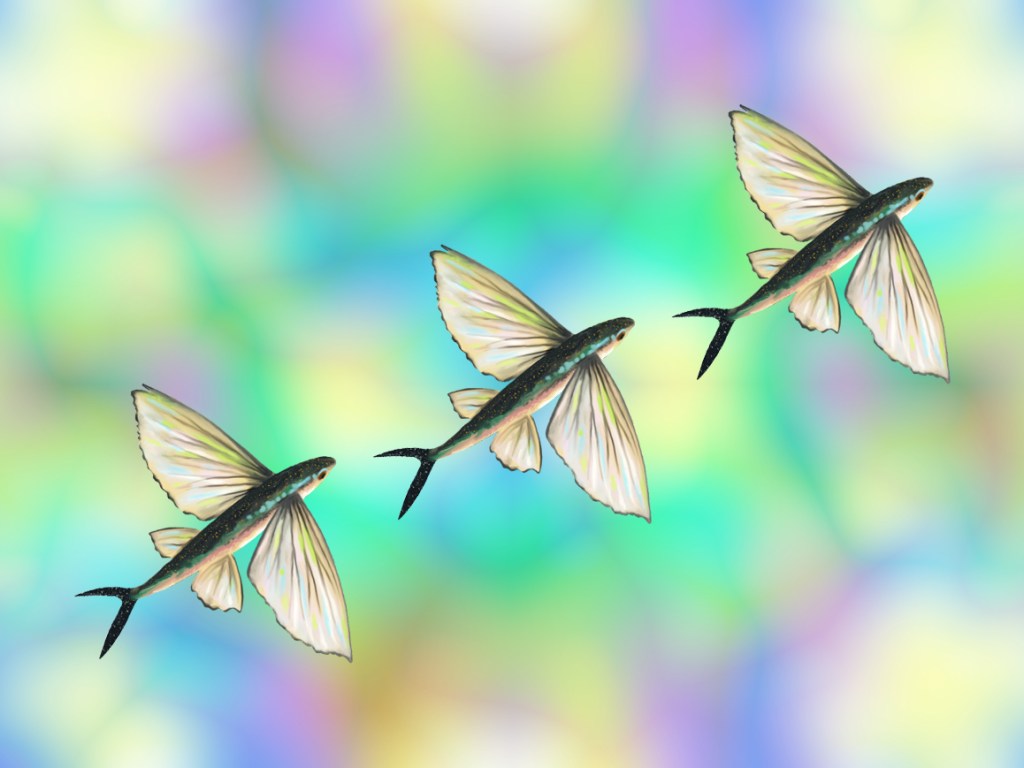
To put it another way, classic books emerge from the constant creation of meaning in the common mind. The meaning is embodied by the messages of the individual writers, emerging out of the common mind like flying fish popping out of the sea. After having been embodied, the meaning returns to the sea— only to pop out again later, in new books, reinvigorated.
I have started to look at many topics that interest me through the eyes of literature, especially fiction. It is not the whole truth. But to me, it is a way to dive into the sea — a way to understand what is going on in the common mind. It is no coincidence that future scenarios are often imagined in fiction way before they become reality. Through written stories, humanity shapes both its past and its future.
My advice to anyone who wants to understand themselves as well as others: read a lot, and seek out classics — both in and out of your comfort zone. You will learn a little bit about all the people who ever read the same text and a little bit about all the people who influenced the writer. And you will find out just how much it´s all connected. Yes, you read right. You can call me a literary conspiracist.
And don´t be afraid of losing yourself in all the thoughts of the world. Indeed, there is a lot both intentionally and unintentionally woven into the stories you read. Unwritten beliefs. Attempts to prove a way of life wrong or right. Politics. Values. I have come to see that reading makes me even more sure of who I am, and what I believe in. I do not have to fear I am unknowingly living in a bubble of my own creation, as the words of myriad intelligent writers have become swords that poke the air around me, time and time over. I have tested my thoughts against the thoughts of many. I am sure you can emerge victorious from that same battle, too.
Let me leave you with my favorite short story by Daniil Kharms, a Soviet-era Russian writer and avant-gardist (translated to English by me, based on the Finnish 1988 translation by Katja Losowitch). Common mind aside; reading his work taught me a lesson on individualism. His stories, while many of them seemingly apolitical, reveal a kind of personality the totalitarian government he was under would not allow to roam free. This particular story seems to be screaming: No matter how dire the circumstances, resistance is always an option! And humor is its fearless ally.
Daniil Kharms – Blue notebook no. 10
Once upon a time, there was a red-haired man who did not have eyes or ears. He did not have any hair either, so the claims of his red hair were made with certain reservations.
He could not talk, because he had no mouth. He did not even have a nose. He did not have arms or legs, either, or stomach, back, spine, or not even any guts. He did not have anything at all! Therefore, it is unclear whom we are talking about.
It is probably best we do not speak of him anymore.
Influential pieces of literature
A list by Tuula Cox (in no particular order)
C.S. Lewis The Chronicles of Narnia, The Screwtape Letters
Alain-Fournier Le Grand Meaulnes
Franz Kafka The Castle, The Metamorphosis
Thomas Mann The Magic Mountain
Hermann Hesse The Glass Bead Game, Narcissus and Goldmund, Strange News from Another Star
Halldór Laxness Salka Valka
Fyodor Dostoevsky Crime and Punishment, Netochka Nezvanova, White Nights
Samuel Beckett Endgame
Frances Hodgson Burnett The Secret Garden
Louisa May Alcott Little Women
Lucy Maud Montgomery Emily series
Leo Tolstoy Anna Karenina
Longus Daphnis and Chloe
J.K.Rowling Harry Potter series
Omar Khayyam The Ruba’iyat of Omar Khayyam
Julio Cortázar Bestiario
Anonymous Epic of Gilgamesh
Priit Pärn Tagurpidi
Ovid The Metamorphoses
Jack Kerouac On the Road
Mikael Niemi Popular Music from Vittula
Milan Kundera The Unbearable Lightness of Being
Gabriel García Márquez One Hundred Years of Solitude
Timo K. Mukka The Earth Is a Sinful Song
Kirsi Kunnas Tiitiäisen satupuu, Tiitiäisen tarinoita
Roald Dahl The Witches, The BFG, Tales of the Unexpected
Erich Maria Remarque All Quiet on the Western Front
Stephen Hawking A Brief History of Time: From the Big Bang to Black Holes
Helen Fielding Bridget Jones’s Diary
Mary Shelley Frankenstein; or, The Modern Prometheus
Edgar Allan Poe The Gold-Bug
Haruki Murakami A Wild Sheep Chase
Nikolai Gogol The Nose
Joel Lehtonen Putkinotko
Lewis Carroll Alice’s Adventures in Wonderland, Jabberwocky
Annette Tison and Talus Taylor Barbapapa
Robert Louis Stevenson Treasure Island, Strange Case of Dr Jekyll and Mr Hyde
Hans Christian Andersen The Little Mermaid, The Nightingale, The Snow Queen
Charlotte Brontë Jane Eyre
Emily Brontë Wuthering Heights
Anne Brontë The Tenant of Wildfell Hall
Jane Austen Pride and prejudice
Daniil Kharms Incidences
Stephenie Meyer The Twilight Saga
Agatha Christie The Murder of Roger Ackroyd
Arthur Conan Doyle A Study in Scarlet
Kazuo Ishiguro Never Let Me Go
J.M. Barrie Peter Pan
Antti Hyry Maantieltä hän lähti
Oscar Wilde The Picture of Dorian Gray
Mikhail Bulgakov The Master and Margarita
Pascal Mercier Night Train to Lisbon
Antoine de Saint-Exupéry The Little Prince
Alexandre Dumas The Count of Monte Cristo
This article was first published on Medium on Sep 12, 2022.
This article was written using only natural stupidity. I hope you get the joke, because I do not want to farm engagement for the real keywords, if I can help it.


Vastaa